
UK Government Achieves Record January Budget Surplus

British government posts unprecedented January surplus as tax receipts exceed forecasts, marking significant fiscal milestone amid economic recovery efforts.
The United Kingdom government has achieved a remarkable fiscal milestone by recording its highest-ever January budget surplus, driven primarily by tax receipts that significantly exceeded official projections. This unprecedented financial performance represents a major turnaround for the Treasury and signals potential strength in the country's economic recovery trajectory. The surplus marks a dramatic shift from previous years when January typically presented challenging fiscal conditions for government finances.
Official data released by the Treasury indicates that government revenue streams performed substantially better than anticipated across multiple taxation categories. Income tax collections, corporation tax receipts, and VAT contributions all exceeded forecasted levels, creating a cumulative effect that pushed the monthly balance into record surplus territory. This robust performance suggests underlying economic activity may be more resilient than previously estimated by government economists and independent forecasters.
The January surplus achievement is particularly noteworthy given the traditional seasonal patterns of government finances. January historically presents challenges for public sector cash flow due to lower economic activity following the holiday period and the timing of various government expenditures. The fact that tax collections not only met but substantially exceeded expectations indicates fundamental strength in the UK's revenue-generating capacity during what is typically a quieter economic month.
Economic analysts attribute the stronger-than-expected performance to several converging factors that have boosted government income streams. Employment levels have remained more stable than projected, supporting income tax and National Insurance contributions. Corporate profitability appears to have recovered more quickly than anticipated, leading to higher corporation tax yields. Additionally, consumer spending patterns have shown resilience, particularly in sectors that generate significant VAT revenue for the Treasury.

The record January surplus provides the government with additional fiscal flexibility as it navigates ongoing economic challenges and policy priorities. This improved financial position could enable increased investment in public services, infrastructure projects, or provide room for potential tax adjustments in future budget announcements. The surplus also strengthens the UK's position when engaging with international financial markets and credit rating agencies.
Treasury officials have expressed cautious optimism about the implications of the January performance while emphasizing the need for sustained monitoring of fiscal trends. The government's ability to generate surplus revenues during traditionally challenging months suggests improved efficiency in tax collection systems and potentially stronger underlying economic fundamentals than reflected in some recent forecasts.
The timing of this fiscal achievement coincides with broader discussions about the UK's economic trajectory and the government's approach to balancing public spending priorities with fiscal responsibility. The surplus performance may influence upcoming policy decisions and provide political capital for the current administration's economic management credentials.
Financial markets have responded positively to news of the record surplus, with government bond yields reflecting increased confidence in the UK's fiscal position. The stronger revenue performance reduces concerns about government borrowing requirements and suggests improved sustainability of public finances. This market confidence could translate into lower borrowing costs for future government debt issuance, creating a virtuous cycle of fiscal improvement.
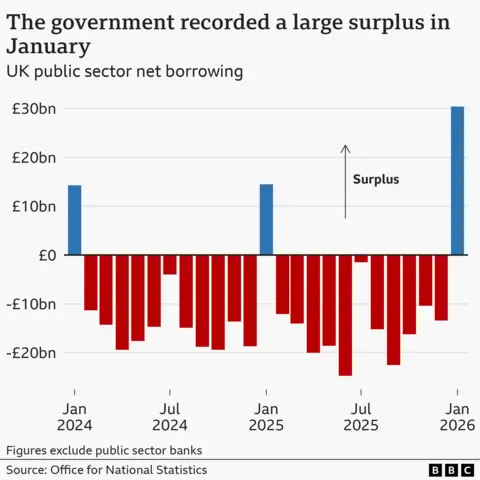
Looking ahead, economists will closely monitor whether the January performance represents a sustainable trend or a temporary boost from exceptional circumstances. The government's ability to maintain strong revenue collection throughout the year will be crucial for meeting annual fiscal targets and supporting longer-term economic planning initiatives.
The record surplus also raises questions about the accuracy of previous revenue forecasting models and whether government economic projections have been overly conservative. This reassessment could influence future budget planning processes and the government's approach to setting fiscal targets and policy objectives.
Industry experts note that while the January results are encouraging, maintaining fiscal discipline and managing expenditure growth will remain essential for preserving the positive trajectory. The government faces ongoing pressures from various sectors demanding increased public investment, making the balance between revenue optimization and spending priorities increasingly important.
The achievement of this record January surplus represents a significant milestone in the UK's fiscal management and provides a foundation for enhanced economic confidence as the country continues navigating post-pandemic recovery challenges and global economic uncertainties.
Source: BBC News


