
Powering Up: Firing America's Most Powerful Lasers

Go behind the scenes of the Texas Petawatt Laser, one of the most powerful lasers in the US. Discover the science and daily operations at this government-funded research center.
Tucked two floors below the University of Texas at Austin's Physics, Math, and Astronomy building, a colossal laser lies hidden from most students' view. This is the Texas Petawatt (TPW) laser, one of the most powerful lasers in the United States and a critical part of the Department of Energy's LaserNetUS network of high-power laser labs.
As the lead laser scientist on the TPW from 2020 to 2024, I had a rare insider's perspective on the daily operations and scientific breakthroughs at this government-funded research center. The TPW laser takes a tiny pulse of light, stretches it out to avoid damaging the optics, and then amplifies it to create a burst of power greater than the entire US electrical grid - all within a trillionth of a second.
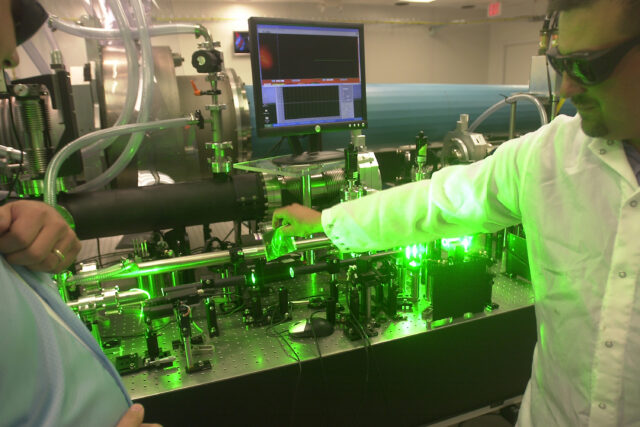
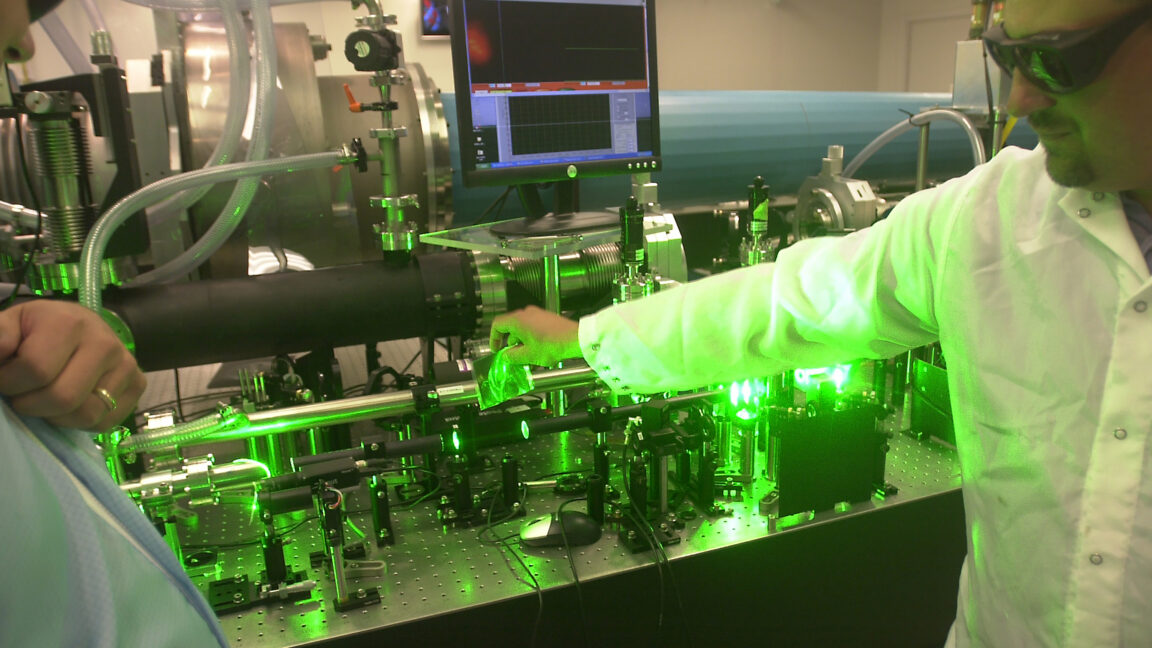
Behind the heavy double doors stamped with the TPW logo, a team of dedicated scientists and engineers worked tirelessly to keep this petawatt-class laser running and enable groundbreaking experiments. From aligning the complex system of mirrors and lenses to fine-tuning the laser pulses, every aspect of the TPW's operation required meticulous precision and expertise.
One of the key challenges was managing the immense power of the laser. With each shot capable of surpassing the grid-level electrical load, the team had to carefully control the energy flow and ensure the laser's optics could withstand the intense light without damage. This required a delicate balance of stretching, amplifying, and compressing the laser pulses to create the desired high-power output.
Despite the technical complexities, the TPW served as a hub for groundbreaking scientific research, attracting researchers from across the country who competed for precious time on this unique facility. From studying the dynamics of plasma physics to exploring the potential of laser-driven fusion, the TPW enabled a wide range of cutting-edge experiments that pushed the boundaries of scientific understanding.
Unfortunately, the TPW's journey came to an end in 2024 due to funding cuts, leaving a void in the nation's high-power laser capabilities. The closure of this facility was a significant loss for the scientific community, as the TPW's unparalleled power and specialized equipment had opened up new frontiers of research.

As I reflect on my time as the lead laser scientist at the Texas Petawatt, I'm struck by the sheer technical complexity and scientific importance of this remarkable laser system. The TPW's ability to generate extraordinary bursts of power, while maintaining the precision and control necessary for groundbreaking experiments, was a testament to the ingenuity and dedication of the entire team involved.
Though the TPW may no longer be operational, the legacy of its scientific achievements and the lessons learned from its operation will continue to shape the future of high-power laser research in the United States and beyond.
Source: Ars Technica


