
Mali Jihadists Burn Vehicles in Fuel Blockade

Extremist groups enforce blockade in Mali, destroying dozens of vehicles. Fuel crisis escalates as landlocked nation faces critical supply disruptions.
Mali, a landlocked West African nation, faces an escalating humanitarian and economic crisis as jihadist militants have systematically torched dozens of vehicles in a coordinated campaign to enforce a devastating blockade across key supply routes. The targeted destruction of commercial and civilian vehicles represents a dramatic escalation in the groups' strategy to destabilize the country's already fragile infrastructure and economy. Security analysts warn that the blockade threatens to exacerbate existing shortages of essential commodities and fuel supplies that the country desperately needs to sustain basic operations.
The blockade operations have primarily targeted major transport corridors that connect Mali to its neighboring countries, effectively cutting off vital supply chains. Fuel transportation networks have been particularly hard hit, with extremist groups establishing checkpoints and enforcing restrictions that prevent tanker trucks and fuel convoys from reaching major population centers. Witnesses have reported scenes of burning vehicles scattered across remote border regions, indicating a systematic approach to preventing resource movement through the country's interior.
Mali's geographic position as a landlocked country creates critical vulnerabilities that militant groups are actively exploiting. Unlike coastal nations with direct access to international waters, Mali depends entirely on overland trade routes through neighboring Senegal, Mauritania, Algeria, Niger, Burkina Faso, and Ivory Coast for all imported goods. This geographic reality means the country has no alternative pathways for essential supplies, making it susceptible to disruption whenever militant groups control key transport corridors.
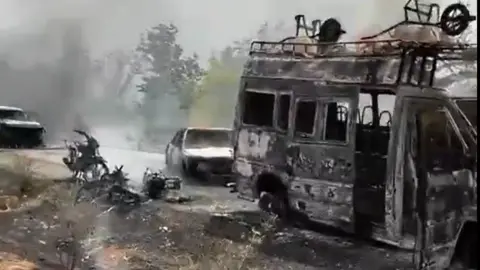
The fuel supply crisis in Mali has reached critical levels, with petroleum products becoming increasingly scarce in urban markets. Gasoline and diesel prices have skyrocketed as merchants struggle to source supplies from international markets, and the blockade has made reaching existing stockpiles nearly impossible. Hospitals, schools, and government offices face severe operational constraints due to fuel shortages, while ordinary citizens grapple with empty fuel stations and explosive price inflation.
Regional analysts have identified this blockade campaign as part of a broader strategy by militant organizations to consolidate control over Mali's resource-rich interior and demonstrate their capacity to disrupt state authority. By targeting fuel convoys and enforcing their own customs procedures at improvised checkpoints, extremist groups are effectively collecting revenue while simultaneously weakening government legitimacy. The destruction of vehicles serves as a deterrent to merchants attempting to bypass their checkpoints or operate outside their control.
The impact of this blockade extends far beyond simple fuel shortages, threatening the entire commercial ecosystem that sustains Mali's economy. Transportation companies have suspended operations on affected routes, forcing traders to seek dangerous alternative pathways or abandon shipments entirely. The cumulative effect has been a sharp contraction in cross-border commerce, reducing customs revenues for the government and limiting access to imported food, medicine, and manufactured goods.

Government authorities have struggled to mount an effective response to the blockade, as security forces remain constrained by limited resources and operational challenges. Military deployments to secure transport corridors have proven inconsistent, and many soldiers lack the fuel necessary to conduct sustained operations. This creates a vicious cycle where fuel shortages limit security operations, which in turn allow militants to maintain their blockade unchecked.
International observers and humanitarian organizations have raised alarms about the humanitarian consequences of the blockade. Medical facilities report critical shortages of fuel for generators, vehicles, and supply distribution networks, directly impacting patient care and disease control efforts. Food supply chains have been severely disrupted, with rural communities facing particular difficulty accessing imports and distributing locally produced goods to urban markets.
The blockade has also disrupted Mali's trade relationships with neighboring countries, creating tensions that extend beyond the immediate conflict zone. Senegal, Mauritania, and other transit nations have expressed concern about the impact on their own economies, as their ports and trade networks depend on moving goods through Mali to regional markets. Cross-border merchant communities that have historically facilitated trade have seen their livelihoods devastated.
The vehicle destruction campaign carries particular symbolic significance, as it demonstrates the militants' willingness to destroy valuable economic assets rather than allow them to function outside their authority. This strategy signals a shift from earlier tactics focused on taxation and control to more aggressive approaches aimed at total economic disruption. The calculated nature of the destruction, targeting multiple vehicle convoys over extended periods, indicates coordinated planning among militant leadership.
Humanitarian access into Mali has become increasingly complicated by the blockade situation. International NGOs and UN agencies operating medical, food, and educational programs face severe restrictions on their ability to import necessary supplies. Some organizations have reduced their presence or suspended operations temporarily, further reducing the international community's capacity to respond to Mali's humanitarian needs.
Regional diplomatic efforts have attempted to negotiate safe passage for humanitarian supplies, with mixed results. Some informal agreements have allowed certain convoys to proceed, but these remain fragile and subject to sudden disruption. The fundamental reality remains that Mali's dependence on imported fuel creates an inherent vulnerability that militant groups continue to exploit systematically.
Economic projections suggest that prolonged blockade conditions could trigger broader economic contraction across Mali's already struggling economy. Business confidence has deteriorated sharply, with merchants reluctant to invest in inventory or expansion given supply uncertainty. Banks have tightened credit conditions, further constraining business activity and employment opportunities throughout the country.
The blockade situation underscores fundamental challenges facing Mali's government in asserting control over its territory and ensuring the free movement of commerce essential for economic function. Without significant improvements in security conditions and government capacity, analysts warn that the blockade could persist indefinitely, creating long-term structural damage to Mali's economy and society. The international community faces difficult choices regarding how to support Mali's stability while respecting sovereignty and navigating complex geopolitical considerations in the region.
Source: BBC News


