
Zelensky's Former Chief of Staff Faces Court Over Corruption Allegations

Andriy Yermak, ex-chief of staff to Ukrainian President Zelensky, appears in court as anti-corruption agencies investigate money-laundering scheme allegations.
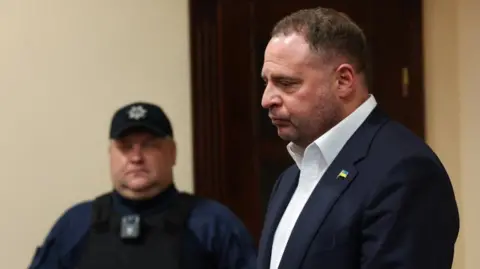
A significant development in Ukraine's corruption investigation has emerged as Andriy Yermak, the former chief of staff to President Volodymyr Zelensky, appeared before the courts amid escalating allegations of financial impropriety. The high-profile legal proceedings mark a critical moment in Ukraine's ongoing efforts to combat government corruption and strengthen institutional accountability within the highest levels of political leadership.
Ukrainian authorities have formally identified Yermak as a suspect in connection with a complex money-laundering scheme, according to findings released by the nation's two principal anti-corruption agencies. These agencies, which operate independently to investigate financial crimes and abuse of power within the government, have built what they characterize as a substantive case against the prominent political figure. The dual investigation underscores the seriousness with which Ukrainian officials are treating the allegations and the coordination between multiple governmental bodies to pursue accountability.
Yermak's role as chief of staff positioned him as one of the most influential figures within the Ukrainian presidential administration during a critical period in the nation's modern history. His responsibilities included managing the presidential office, coordinating policy initiatives, and serving as a key advisor to Zelensky on matters of national importance. The allegations against him represent a notable challenge to the administration's credibility on anti-corruption efforts, particularly as Ukraine seeks to strengthen democratic institutions and combat systemic financial crimes.
The corruption investigation has intensified over recent months as anti-corruption authorities have expanded their examination of financial transactions and dealings allegedly involving Yermak and associated parties. Sources close to the investigation suggest that the probe has uncovered documentation pointing to complex financial movements that authorities believe warrant criminal investigation. The specifics of the money-laundering allegations remain partly confidential as the case proceeds through preliminary judicial proceedings, a standard protocol in Ukrainian criminal investigations.
This development carries significant implications for Ukraine's international standing and its relationship with Western allies who have emphasized the importance of anti-corruption measures as a prerequisite for continued support and integration with European and international institutions. The European Union and United States have consistently advocated for Ukraine to strengthen its institutional frameworks combating corruption, and the high-profile prosecution of a former presidential advisor signals a willingness to pursue accountability regardless of political position.
The appearance of Yermak in court represents a pivotal moment in Ukraine's judicial system, demonstrating the capacity of anti-corruption institutions to investigate and prosecute individuals at the highest echelons of government. Observers of Ukrainian politics have noted that such investigations at this level were historically rare, making the current legal proceedings a reflection of institutional evolution and growing independence of the judiciary from executive interference.

The investigation encompasses multiple dimensions of alleged financial misconduct, including the movement of funds through various channels and the potential involvement of intermediaries in facilitating the alleged scheme. Investigators have reportedly examined bank records, financial statements, and communications related to the transactions in question. The methodical nature of the inquiry reflects the complexity involved in prosecuting money-laundering charges, which typically require substantive documentary evidence and forensic financial analysis.
Yermak's legal team has indicated that he disputes the allegations and maintains his innocence regarding the corruption charges. The defense strategy is expected to challenge the evidentiary foundation of the prosecution's case and question the investigative methodology employed by anti-corruption agencies. These preliminary court proceedings will likely establish the framework for subsequent phases of the judicial process and determine whether sufficient grounds exist to proceed with formal charges.
The timing of the court appearance and the escalation of the Ukraine corruption probe occur within the broader context of the nation's ongoing efforts to reform its governance structures and eliminate systemic corruption. International observers and civic organizations within Ukraine have called for transparent handling of the case and adherence to due process protections. The outcome of Yermak's proceedings could influence public perception of whether Ukraine's anti-corruption institutions operate with genuine independence or remain subject to political influence.
The involvement of both of Ukraine's major anti-corruption agencies in the investigation suggests a coordinated effort to ensure comprehensive scrutiny of the allegations. These agencies typically specialize in different aspects of financial crimes and government accountability, and their combined engagement indicates the gravity with which authorities view the case. The collaboration between these bodies also reinforces the notion that the investigation has proceeded through proper institutional channels rather than being driven by partisan political motivations.
Legal experts specializing in Ukrainian criminal law have noted that the prosecution of individuals holding senior government positions presents unique challenges related to evidentiary standards, witness protection, and potential political pressure. The court's handling of the Yermak case may establish important precedents for how Ukrainian judicial institutions manage high-profile corruption prosecutions. The independence and impartiality of the judiciary will be under close scrutiny as the proceedings unfold.
As the investigation progresses through the court system, various stakeholders including civil society organizations, international observers, and members of the Ukrainian public will monitor developments closely. The case represents a test of Ukraine's commitment to institutional accountability and its capacity to enforce the rule of law equitably across different social strata and political affiliations. The eventual outcome will likely carry symbolic significance for Ukraine's broader anti-corruption agenda and its standing within the international community.
The proceedings involving Yermak demonstrate that even prominent government officials are not exempt from criminal investigation and prosecution when authorities identify evidence of wrongdoing. This principle is fundamental to establishing functional democracies and institutions capable of self-correction and accountability. Ukraine's willingness to pursue these charges against a former presidential advisor, despite potential political costs, reflects a commitment to institutional integrity that observers hope will become increasingly normalized within the country's governance structure.
Source: BBC News


