
Thai Police Use Lion Dance Disguise to Catch Art Thief

Bangkok police officers dressed as traditional lion dancers during Lunar New Year to arrest suspect who stole $64,000 worth of Buddhist artifacts.
In an extraordinary display of creative policing, Thai law enforcement officers employed an unconventional undercover operation this week, disguising themselves as traditional lion dancers during Lunar New Year celebrations to apprehend a suspect accused of a significant art theft. The innovative sting operation resulted in the arrest of a man believed to have stolen approximately $64,000 worth of Buddhist artifacts from a residential property in Bangkok's suburban areas.
The elaborate ruse unfolded on Wednesday evening as communities across Thailand celebrated the Lunar New Year festivities with traditional performances and cultural displays. Officers from the Bangkok Metropolitan Police strategically positioned themselves within the celebratory atmosphere, donning an eye-catching red-and-yellow lion costume that allowed them to blend seamlessly into the festive environment while maintaining surveillance on their target.
The operation was initiated following a burglary report filed earlier this month by residents in Bangkok's suburban districts. The victims reported the theft of numerous Buddhist religious artifacts from their home, items that hold both significant cultural value and considerable monetary worth. The stolen pieces included intricately crafted statues, ceremonial objects, and other sacred items that are deeply revered in Thai Buddhist culture.
According to police sources, the investigation had been ongoing for several weeks, with officers gathering intelligence and tracking the movements of the primary suspect. The breakthrough came when investigators learned that the individual would be present at the Lunar New Year celebrations, providing an opportunity for arrest without causing public alarm or disrupting the peaceful festivities.
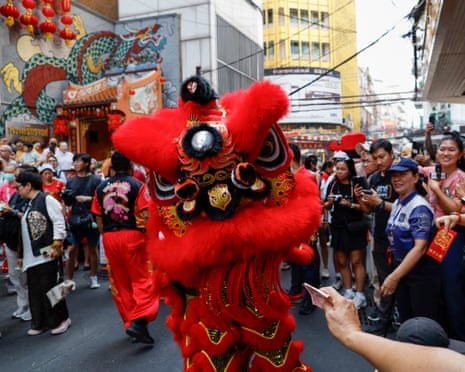
The undercover lion dance operation represents a remarkable example of community-oriented policing, where law enforcement adapts to local customs and celebrations to maintain public safety. The officers' ability to execute the arrest while maintaining the joyful atmosphere of the cultural celebration demonstrates the Thai police force's commitment to preserving both security and cultural harmony.
Buddhist artifacts hold immense significance in Thai society, where approximately 95% of the population practices Buddhism. These items are not merely decorative objects but are considered sacred representations of spiritual teachings and cultural heritage. The theft of such items is particularly serious in Thailand, where respect for religious symbols and artifacts is deeply ingrained in the social fabric.
The suspect, whose identity has not been publicly released pending further legal proceedings, was taken into custody without incident during the evening festivities. Witnesses reported that the arrest was conducted so smoothly that many celebrants were unaware that a law enforcement operation was taking place among the traditional performances and cultural displays.
This creative approach to policing reflects broader trends in modern law enforcement, where officers increasingly employ innovative methods to solve crimes while minimizing public disruption. The success of the lion dance operation may inspire similar creative approaches in future investigations, particularly during cultural events and public gatherings.
The recovered artifacts are expected to be returned to their rightful owners following the completion of evidence processing and legal procedures. Police investigators are also examining whether the suspect may be connected to other similar thefts in the Bangkok metropolitan area, as the theft of religious artifacts has been an ongoing concern for local authorities.
The timing of the arrest during Lunar New Year celebrations adds symbolic significance to the operation, as the festival traditionally represents new beginnings, good fortune, and the triumph of good over evil. For the victims of the burglary, the successful apprehension of the suspect and the recovery of their sacred items provides a particularly meaningful resolution during this auspicious time.
Local community leaders have praised the police department's sensitive handling of the situation, noting that the officers' respect for cultural traditions while pursuing justice exemplifies the best practices in community policing. The operation has been widely shared on social media, with many Thai citizens expressing appreciation for the creative and culturally aware approach taken by law enforcement.
This case highlights the ongoing challenges faced by law enforcement in protecting cultural heritage and religious artifacts from theft. As these items often have significant value on both legal and illegal markets, they present attractive targets for criminals while representing irreplaceable losses for their rightful owners and communities.
The Bangkok Metropolitan Police have indicated that the investigation remains active as they work to determine whether additional stolen items may be recovered or if other suspects were involved in the burglary operation. The successful conclusion of this case demonstrates the effectiveness of combining traditional investigative techniques with innovative undercover operations tailored to specific cultural contexts.
As Thailand continues to modernize its law enforcement approaches while maintaining respect for traditional values and customs, operations like the lion dance arrest serve as models for how police can effectively serve their communities. The balance between maintaining public safety and preserving cultural celebrations represents a crucial aspect of effective policing in diverse, culturally rich societies.
The case also underscores the importance of community cooperation in solving crimes, as the initial burglary report and subsequent community information helped police track down the suspect. This collaborative approach between citizens and law enforcement remains essential for maintaining safety and security while preserving the cultural traditions that define Thai society.
Source: The Guardian


