
South Carolina GOP Defies Trump on Redistricting

Republican senators resist presidential pressure to redraw congressional map following Supreme Court ruling. Majority leader cites state interests.
South Carolina state senators made a bold political move on Tuesday, directly defying intense pressure from Donald Trump to approve plans for redrawing the state's congressional map. This decision came in the aftermath of a significant US Supreme Court ruling that effectively gutted critical protections within the Voting Rights Act, a landmark piece of civil rights legislation that had previously prevented racial discrimination in electoral processes.
The confrontation between state Republicans and the former president represents a rare moment of internal party conflict, highlighting the complex political dynamics at play in post-2024 American politics. As redistricting efforts have accelerated across multiple states following the Supreme Court's controversial decision, South Carolina's Republican leadership has emerged as an unexpected voice of resistance against Trump's demands for more aggressive map redrawing.
Shane Massey, who serves as the Republican majority leader in South Carolina's state senate, delivered what observers described as an extraordinary and principled address to his colleagues. In his remarks, Massey argued persuasively that approving the proposed redistricting plans would ultimately work against the broader interests of South Carolina and its residents, despite mounting pressure from party leadership at the national level.
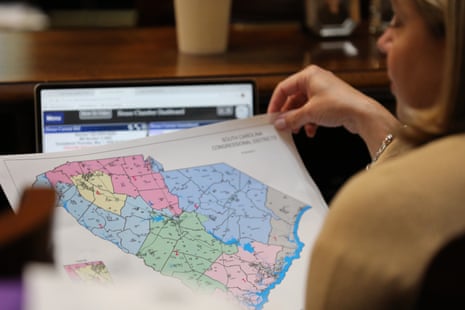
The backdrop for this dramatic political showdown involves the Supreme Court's recent decision, which fundamentally altered the landscape of voting rights protection in America. By rendering ineffective a major section of the Voting Rights Act, the court removed crucial federal oversight mechanisms that had been in place for decades to prevent discriminatory redistricting practices. This decision opened the door for states to pursue more aggressive congressional redistricting without the same level of federal scrutiny that previously existed.
Massey's public resistance to Trump's demands represents a significant moment for South Carolina Republicans, who find themselves caught between competing pressures. On one hand, there is intense pressure from Trump and his allies within the Republican Party to use the Supreme Court's ruling as an opportunity to strengthen Republican electoral prospects through strategic redistricting. On the other hand, state legislators like Massey are arguing for a more measured approach that prioritizes what they view as the genuine interests of South Carolina.
The Republican majority leader's willingness to publicly challenge the former president carries substantial political risk. In acknowledging what he characterized as the "likely consequences" for resisting Trump's demands, Massey demonstrated both his resolve and his clear understanding of the precarious position he was placing himself in within the current Republican political landscape. Trump has demonstrated a strong tendency to punish those who defy him, and Massey's stance puts him at odds with a significant faction of his own party.
This situation reflects deeper tensions within the Republican Party regarding redistricting strategy and the proper role of federal court decisions in state political processes. While some Republicans view the Supreme Court's gutting of the Voting Rights Act as an opportunity to pursue aggressive redistricting strategies, others like Massey argue that such approaches may ultimately prove counterproductive or damage the state's political fabric.
The South Carolina standoff also raises important questions about the nature of political loyalty and party unity. Trump has cultivated a base within the Republican Party that expects unwavering allegiance to his agenda and directives. When state-level Republican leaders like Massey push back, they risk invoking the former president's considerable influence within the party, potentially facing primary challenges from Trump-endorsed candidates in future elections.
Massey's position gains additional significance when considered within the broader context of recent electoral politics and the ongoing battle over voting rights in America. The Supreme Court's decision to weaken the Voting Rights Act has been controversial across the political spectrum, with civil rights advocates arguing that it removes crucial protections for minority voters and potentially enables discriminatory redistricting practices.
The role of the Voting Rights Act in American electoral politics cannot be overstated. For decades, this landmark 1965 legislation provided federal oversight and protection against voting discrimination, particularly in states with histories of racial discrimination. The Supreme Court's recent decision to undermine these protections has opened a new chapter in the ongoing struggle over voting rights and electoral fairness in the United States.
As South Carolina Republicans wrestle with this decision, they must balance multiple considerations. There are the immediate political pressures from Trump and his supporters who want to capitalize on the Supreme Court's decision. There are also longer-term considerations about the state's political stability, the integrity of its electoral processes, and the potential legal and political consequences of aggressive redistricting efforts.
Massey's public stance suggests that at least some Republican state legislators are taking these broader considerations seriously, even at considerable personal political risk. His willingness to acknowledge the likely consequences of defying Trump while still proceeding with his stated position demonstrates a level of principle that has become increasingly rare in contemporary Republican politics.
The situation in South Carolina also highlights the ongoing evolution of American electoral politics in the post-Trump era. The former president's influence within the Republican Party remains substantial, but his ability to enforce complete obedience appears to have limits, at least in some contexts. The willingness of state-level leaders like Massey to resist pressure from the national party suggests that political decision-making at the state level continues to operate according to somewhat different calculi than national party politics.
Moving forward, the outcome of South Carolina's redistricting deliberations could have significant implications for both state and national politics. If South Carolina Republicans ultimately resist Trump's demands and adopt a more moderate redistricting approach, it could embolden other state-level Republicans to similarly defy national party pressure. Conversely, if Trump successfully pressures South Carolina to proceed with aggressive redistricting despite Massey's objections, it would reinforce the former president's control over the Republican Party apparatus.
The South Carolina redistricting controversy serves as a important reminder that American politics remains fundamentally shaped by tensions between national and local interests, between party loyalty and individual conscience, and between different visions of how electoral processes should function. As the battle over voting rights and electoral fairness continues to unfold across America, the decisions made by state-level Republican leaders like Shane Massey may prove to be historically significant.
Source: The Guardian


