
Russian Strikes Devastate Ukraine: Death Toll Rising

Massive Russian military strikes across Ukraine overnight have resulted in casualties. Rescue teams urgently search through rubble of damaged residential buildings in Kyiv.
Overnight Russian strikes have unleashed a devastating barrage across multiple Ukrainian cities, leaving a trail of destruction and prompting immediate emergency response operations. According to officials coordinating the disaster relief efforts, at least one person has been confirmed dead in the attacks, with rescue teams working frantically to locate additional survivors trapped beneath collapsed structures. The scale of the Ukrainian military assault marks another escalation in the ongoing conflict that has ravaged the nation for months.
In the capital city of Kyiv, emergency responders have concentrated their efforts on a residential building that sustained direct impact during the nighttime bombardment. Search and rescue personnel are methodically combing through the rubble and debris, utilizing specialized equipment and trained rescue dogs to locate any individuals who may be trapped or injured in the wreckage. The dangerous conditions and unstable structural integrity of the damaged building present significant challenges for the rescue operations currently underway.
Ukrainian officials have indicated that the attacks represent a coordinated assault targeting civilian infrastructure rather than military installations. This pattern of targeting residential areas has drawn international concern and condemnation from world leaders who view such actions as violations of international humanitarian law. The Russian military campaign has consistently focused on areas populated by civilians, creating widespread panic among the Ukrainian population.
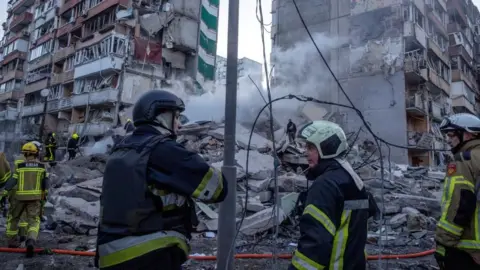
The emergency services in Kyiv have activated their full disaster response protocol, deploying additional ambulances, medical personnel, and heavy machinery to assist in the recovery operation. Local hospitals have prepared to receive injured survivors, with medical staff standing by to provide immediate treatment for trauma and injuries sustained during the strikes. The coordination between various government agencies and emergency services has been crucial in managing the crisis response efficiently.
Residents throughout the capital city reported experiencing powerful explosions during the early morning hours, with many describing the intensity of the blasts and the subsequent fires that ignited in multiple locations. The psychological impact on the civilian population continues to mount as residents face repeated threats to their safety and the constant uncertainty of future attacks. Many families have sought shelter in underground bunkers and metro stations that have been converted into makeshift safe havens.
The broader context of these Russian attacks on Ukraine reflects the intensifying military campaign that has characterized recent months of the conflict. Intelligence assessments suggest that Russia continues to employ long-range missiles and artillery to strike targets across Ukrainian territory, demonstrating a sustained commitment to prolonging the military engagement. The attacks on civilian infrastructure appear designed to demoralize the population and disrupt essential services.
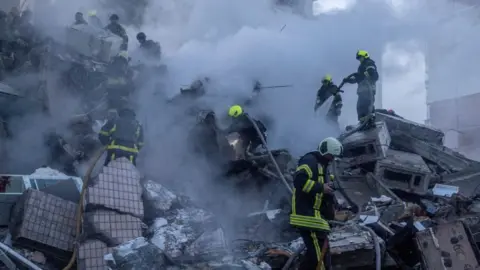
Infrastructure damage from these overnight strikes extends beyond the singular residential building, with reports indicating that utilities, transportation networks, and commercial establishments have also sustained significant harm. Power outages have affected numerous neighborhoods, leaving residents without electricity and complicating rescue and recovery operations. Water supply disruptions have added to the humanitarian challenges facing the affected communities.
International observers monitoring the situation have documented the pattern of attacks and their impact on civilian populations, with humanitarian organizations preparing comprehensive reports for the international community. The Ukraine conflict has attracted sustained attention from global media outlets and international bodies concerned with human rights and civilian protection. These documented incidents contribute to ongoing investigations into potential war crimes and violations of the Geneva Conventions.
The resilience demonstrated by Ukrainian citizens and emergency personnel has become increasingly apparent as they face repeated crises and threats. Community members have mobilized to support rescue operations, providing supplies, information, and assistance to emergency responders working in dangerous conditions. The solidarity shown among residents has become a defining characteristic of the Ukrainian response to the ongoing military campaign.
Government officials have pledged continued commitment to protecting civilian lives and pursuing accountability for attacks targeting non-military targets. International diplomatic efforts continue to seek peaceful resolution, though military operations show no signs of immediate cessation. The humanitarian toll continues to accumulate with each day of continued conflict, affecting millions of Ukrainian civilians.
Looking forward, the priorities for Ukrainian authorities include completing the current rescue operations, providing medical care to the injured, and assessing the full extent of damage to critical infrastructure. Reconstruction planning is already underway in some communities, though many remain under active threat from continued military operations. The long-term consequences of the sustained Russian military campaign will likely affect Ukraine's development and stability for years to come.
Source: BBC News


