
Prince Andrew May Lose Royal Succession Rights

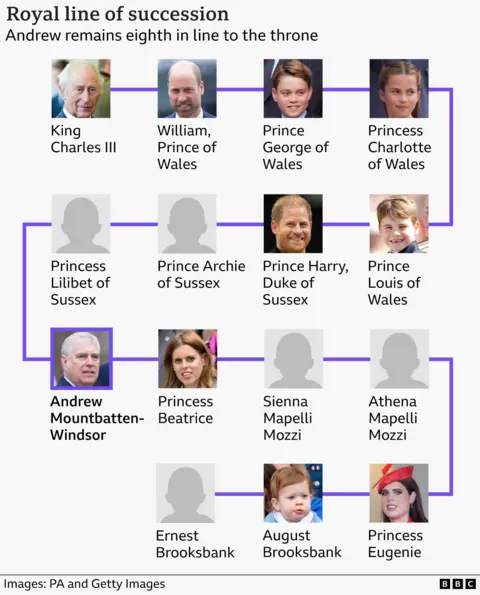
Government explores removing Prince Andrew from royal line of succession despite remaining eighth in line to throne after losing titles over scandal.
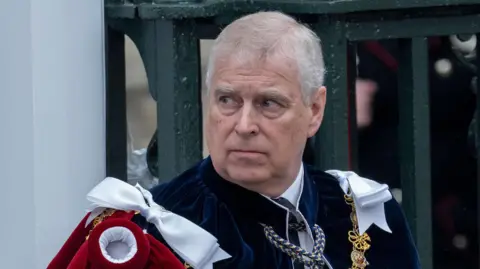
The British government is actively exploring the unprecedented possibility of removing Prince Andrew from the royal line of succession, according to sources close to Westminster. The former Duke of York currently maintains his position as eighth in line to the throne, a status that theoretically keeps him eligible for the crown despite the significant controversies that have engulfed his public life in recent years.
Prince Andrew, who is King Charles III's younger brother, has managed to retain his place in the succession order even after facing severe consequences for his association with convicted paedophile financier Jeffrey Epstein. The royal's connections to Epstein have created an ongoing constitutional dilemma for both the monarchy and the government, raising questions about the appropriateness of maintaining succession rights for someone whose reputation has been so thoroughly tarnished.
Last October marked a significant turning point in Andrew's royal status when he was officially stripped of his military titles and royal patronages. The decision, announced by Buckingham Palace, came amid mounting pressure from the public, military veterans, and political figures who argued that his continued association with the monarchy was damaging the institution's reputation. The palace statement indicated that Andrew would no longer use the title 'His Royal Highness' in any official capacity.
The removal of Andrew's titles represented one of the most dramatic falls from grace in modern royal history. However, despite these punitive measures, his position in the line of succession remained untouched, creating what constitutional experts describe as an anomalous situation where someone deemed unfit for royal duties could theoretically still ascend to the throne.
Constitutional lawyers have been examining the complex legal mechanisms that would be required to formally remove Andrew from the succession. Such action would likely require new legislation, as the current laws governing royal succession are deeply embedded in centuries of constitutional tradition and statute law. The Succession to the Crown Act 2013 reformed succession rules to ensure gender equality, but did not address provisions for removing individuals based on conduct or suitability.
Government sources, speaking on condition of anonymity, suggest that discussions have been taking place at the highest levels about the feasibility and desirability of taking such unprecedented action. These conversations reportedly involve senior civil servants, constitutional experts, and political advisors who are carefully weighing the implications of intervening in royal succession matters.
The potential removal would set a remarkable precedent in British constitutional history. Previous changes to the line of succession have typically occurred through voluntary abdication, as in the case of King Edward VIII in 1936, rather than through parliamentary intervention. The Edward VIII crisis, which arose from his determination to marry American divorcee Wallis Simpson, ultimately resolved itself through the king's decision to abdicate, avoiding the need for legislative action.
However, Andrew's situation presents a different set of challenges. Unlike Edward VIII, who chose to relinquish his rights, Andrew has shown no indication of voluntarily stepping aside from his succession position. This reluctance has prompted government officials to explore alternative mechanisms for achieving what many view as necessary constitutional reform.
Legal experts emphasize that removing someone from the royal line of succession would require careful consideration of multiple factors beyond the immediate circumstances. Any legislation would need to establish clear criteria for future removals, potentially creating a framework for parliament to intervene in succession matters under specific circumstances such as criminal conviction, moral turpitude, or actions deemed incompatible with royal duties.
The Andrew controversy has also reignited broader debates about the role and relevance of the monarchy in contemporary British society. Critics argue that the situation demonstrates the outdated nature of hereditary privilege, while supporters of the monarchy contend that swift action to address problematic members shows the institution's ability to adapt and maintain public confidence.
Public opinion polls consistently show overwhelming disapproval of Prince Andrew's conduct and strong support for his removal from any official royal role. A recent survey indicated that more than 80% of respondents believed Andrew should be completely excluded from the line of succession, reflecting the depth of public sentiment on the issue.
The implications of removing Andrew extend beyond the immediate case to questions about the monarchy's future governance. Some constitutional scholars suggest that establishing a parliamentary mechanism for succession removal could provide valuable safeguards for the institution, ensuring that future controversies could be addressed more swiftly and decisively.
King Charles III faces a particularly delicate balancing act as he navigates this unprecedented situation involving his brother. The new monarch has already demonstrated his commitment to a streamlined royal family by limiting working royals to a core group of senior members. However, the Andrew situation requires him to balance family loyalty with institutional integrity and public expectations.
Palace insiders suggest that Charles is supportive of efforts to address the Andrew problem definitively, recognizing that leaving the matter unresolved could continue to overshadow his reign. The king's reported willingness to consider dramatic action reflects his understanding that protecting the monarchy's long-term reputation may require difficult short-term decisions.
The timeline for any potential legislative action remains unclear, with government sources indicating that extensive consultations would be necessary before proceeding. These discussions would likely involve the Prime Minister, senior cabinet members, constitutional experts, and potentially representatives of other Commonwealth realms where the British monarch serves as head of state.
Opposition politicians have generally supported the principle of removing Andrew from the succession, though some have questioned why action was not taken sooner. Labour MPs have particularly criticized the government's slow response to what they characterize as a clear threat to constitutional propriety and public confidence in democratic institutions.
The international dimensions of the controversy also complicate the government's considerations. Andrew's association with Epstein and the subsequent legal proceedings attracted global attention, potentially affecting Britain's international reputation and diplomatic relationships. Foreign policy experts suggest that resolving the Andrew situation could help restore confidence in British institutions among international partners.
As discussions continue behind closed doors, the unprecedented nature of the situation ensures that whatever action is ultimately taken will establish important constitutional precedents for future generations. The removal of Prince Andrew from succession would represent one of the most significant constitutional developments of the modern era, fundamentally altering the relationship between parliament, the monarchy, and the line of succession.
The outcome of these deliberations will likely influence not only Andrew's future but also the broader evolution of the British monarchy in the 21st century, potentially providing a template for addressing similar challenges that may arise in the future.
Source: BBC News


