
Labour Faces Major Setback as Reform UK Surges

Labour suffers significant losses in English local elections while Reform UK makes dramatic gains across key constituencies including Hartlepool and the north-east.
Labour's electoral troubles deepened dramatically following Thursday's local elections across England, as the party experienced substantial losses in councillor representation and Reform UK emerged as a major challenger in several key regions. The results revealed a significant shift in voter sentiment, with particular alarm bells ringing for Prime Minister Keir Starmer as traditional Labour strongholds showed signs of weakness and defection to the insurgent Reform party.
The scale of Labour's electoral challenge became unmistakably clear overnight as results rolled in from councils across the nation. Starmer's administration had braced itself for significant losses heading into Thursday's contest, with party insiders and senior figures openly acknowledging the election would be "tough" and potentially costly in terms of council representation. However, the actual magnitude of the defeat appears to have exceeded even the most pessimistic internal forecasts, with the party haemorrhaging councillors at an alarming rate.
In a striking development that captured national attention, Reform UK became the runaway winner in the north-east region, a historically Labour-dominated area that has backed the party for generations. This breakthrough performance by the upstart political force signals a fundamental realignment in regional politics, with voters in traditional Labour heartlands evidently willing to experiment with alternatives to Starmer's government.

Most significantly, Hartlepool appears to have been lost entirely to Reform UK, marking a dramatic reversal for Labour in what had been considered a core constituency. This particular result carries symbolic weight, as Hartlepool has served as a bellwether for Labour's fortunes in recent years. The loss represents not merely a statistical defeat but a fundamental breach in Labour's electoral coalition, particularly among working-class voters who have traditionally formed the party's base.
Beyond the north-east stronghold, Labour suffered notable defeats in multiple English councils during the local elections. Constituencies including Chorley, Wigan, Redditch, and Tamworth all recorded losses for the governing party, spreading the electoral pain across different regions and demographic areas. These defeats were not concentrated in any single area but rather represented a broad-based rejection that suggests systemic problems with Labour's current standing among local voters.
The party had anticipated losing up to 1,850 councillors before the elections took place, according to projections made by senior Labour figures who were attempting to manage expectations heading into the contest. This pre-election forecast itself indicated the challenging political environment facing the government, yet the actual results appear to confirm and potentially exceed these gloomy predictions. The loss of nearly 1,850 elected representatives across the country represents a substantial erosion of Labour's local government power base.

Reform UK's performance marks a watershed moment in British electoral politics, demonstrating that the party has successfully translated protest sentiment and voter dissatisfaction into actual electoral gains. The insurgent party's breakthrough in multiple regions suggests it has developed sufficient organizational capacity and policy appeal to compete effectively with established political forces. This development reshapes the competitive landscape in British politics and complicates the strategic calculations for both Labour and the Conservative Party.
The geographic pattern of Reform's gains is particularly significant, with the north-east emerging as a stronghold. This region, which encompasses areas like County Durham, Tyne and Wear, and Northumberland, has undergone considerable demographic and economic change in recent decades. The success of Reform in precisely these areas suggests the party has effectively mobilized voters around specific regional grievances and national concerns that resonate particularly strongly in post-industrial communities.
For Prime Minister Keir Starmer, these election results create significant political challenges as he attempts to govern with his party's authority under question. The erosion of Labour's council presence reduces the party's footprint in local government and weakens its institutional base in communities across England. Furthermore, the shift of voters toward Reform suggests that a portion of Labour's traditional support base has lost confidence in the party's ability to address their concerns and priorities.

The scale of the challenge is further illustrated by the concentration of Reform strength in the north-east, where the party achieved "runaway" success according to electoral observers. This dominant performance in a single region provides Reform with a geographic powerbase that can serve as a launching pad for further expansion in future elections. The party has effectively demonstrated that it can achieve victory not just in protest votes but in actual electoral competition across multiple council seats.
Labour's losses extend beyond headline figures to include the psychological impact of ceding territory to a challenger that barely existed as a significant political force just months earlier. The emergence of Reform UK as an electoral force represents one of the most significant developments in British politics in recent years, challenging the traditional two-party and two-and-a-half party system that has dominated for decades. The speed of Reform's rise from marginal movement to council-winning force underscores the depth of voter dissatisfaction with existing political options.
Looking forward, these local election results will inevitably influence the political calculation for both Labour and Conservative leaders. Labour must now contend with the challenge of halting its momentum loss while also managing internal party dynamics regarding strategy and messaging. The party's senior figures, who had described the election as "tough" before results came in, will face scrutiny regarding their strategic direction and capacity to reconnect with voters in regions where Labour has long held sway.
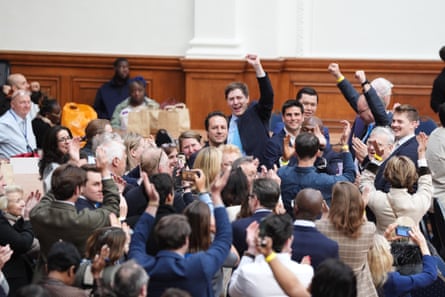
The broader implications of these local election results extend beyond immediate party politics to encompass questions about voter engagement, regional inequality, and the effectiveness of national government messaging at the local level. The local elections of 2026 have clearly demonstrated that significant shifts in voter sentiment are underway, with traditional patterns of allegiance being broken and new political alignments beginning to form across multiple regions of England.
Source: The Guardian


