
Google Gemini 3.5 Flash Matches Top AI Models for Code

Google's new Gemini 3.5 Flash AI model delivers flagship-level performance for coding and automation tasks while running significantly faster than competitors.
Google has unveiled impressive capabilities for its Gemini 3.5 Flash model, demonstrating that the lightweight artificial intelligence system can achieve performance levels comparable to much larger, more resource-intensive flagship models. The tech giant claims its latest offering completes complex tasks in a fraction of the time required by competing frontier models, positioning it as a game-changer for developers and enterprises seeking efficient AI solutions.
The Gemini 3.5 Flash model represents a significant advancement in Google's AI portfolio, specifically engineered to deliver rapid inference speeds without sacrificing the quality of outputs. Google's engineering team has focused on optimizing the model architecture to handle computationally demanding scenarios, including sophisticated coding challenges and autonomous agent operations, where speed and accuracy are equally critical. This breakthrough addresses a persistent challenge in the AI industry: balancing model capability with operational efficiency.
According to Google's official statements, the new AI model performs at competitive levels with large flagship models when evaluated on coding benchmarks and agentic task completion metrics. The company emphasizes that Gemini 3.5 Flash achieves this performance parity while maintaining substantially faster response times, making it an attractive option for time-sensitive applications where latency can significantly impact user experience and operational costs.
For software development teams, coding task performance has become increasingly important as AI-assisted programming tools gain mainstream adoption. Gemini 3.5 Flash's ability to rival larger models in this domain means developers can leverage Google's technology for code generation, debugging, refactoring, and optimization without waiting extended periods for responses. This improvement could accelerate development cycles and reduce infrastructure expenses associated with running larger, more computationally demanding models.
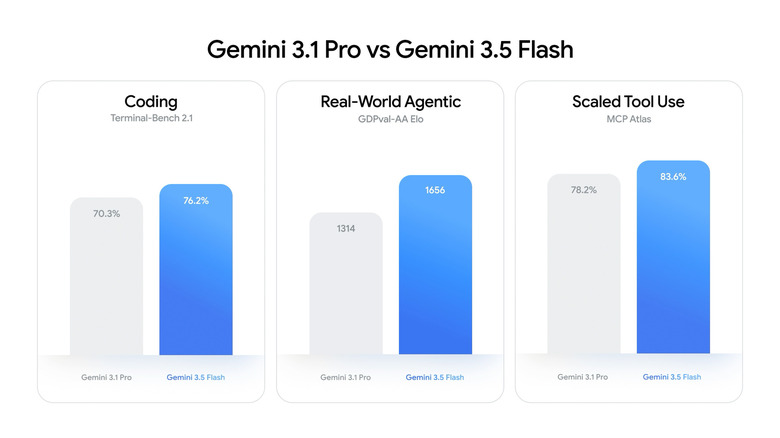
The agentic task capabilities of Gemini 3.5 Flash represent another critical advancement, as autonomous agents are becoming increasingly important in enterprise automation scenarios. These systems can perform multi-step operations, make decisions based on context, and adapt to changing conditions—all essential skills for automating complex business processes. The fact that Gemini 3.5 Flash handles agentic tasks at or above the level of larger models while operating faster suggests significant practical applications across various industries.
Google's approach with Gemini 3.5 Flash reflects broader industry trends toward developing more efficient AI systems. As organizations face mounting pressure to reduce computational costs and environmental impact, efficient AI models like Gemini 3.5 Flash offer a compelling alternative to massive language models that require substantial energy consumption and infrastructure investment. This shift toward efficiency without compromising capability could reshape how enterprises deploy and utilize artificial intelligence technologies.
The timing of this announcement coincides with intensifying competition in the AI space, where companies like OpenAI, Anthropic, and Meta are continuously pushing the boundaries of what's possible with language models and specialized AI systems. Google's emphasis on performance per unit of computational resource positions it strategically in a market where organizations increasingly scrutinize not just model capabilities but also cost-effectiveness and environmental sustainability metrics.
From a practical standpoint, developers using Google's platforms now have access to a tool that balances sophistication with speed, potentially reducing both development time and operational expenses. The Gemini 3.5 Flash model's efficiency could prove particularly valuable for startups and smaller organizations that lack the resources to maintain expensive infrastructure for running the largest available AI models.
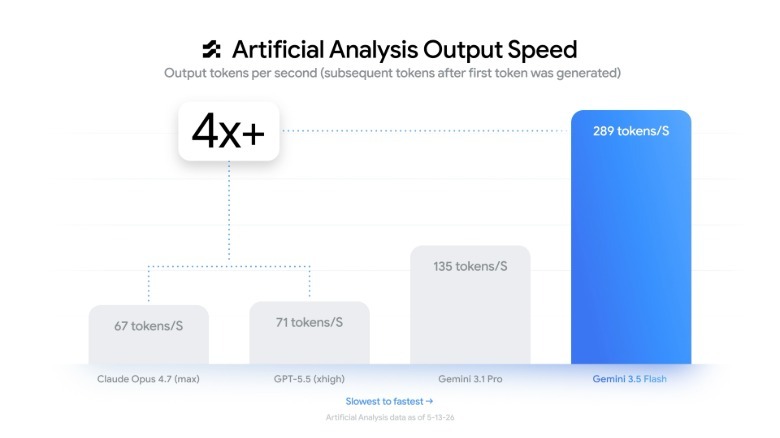
Google has positioned the Gemini 3.5 Flash model as part of its broader commitment to democratizing advanced AI capabilities, making powerful tools accessible to a wider range of users and organizations. By prioritizing speed alongside accuracy, the company acknowledges that real-world applications often prioritize responsiveness and efficiency over marginal improvements in output quality. This pragmatic approach reflects lessons learned from deploying AI systems at scale across Google's own products and services.
The coding assistance features of Gemini 3.5 Flash are particularly notable for their ability to handle context-rich prompts and generate syntactically correct code across multiple programming languages. Whether developers are working with Python, JavaScript, Java, or other popular languages, the model's training enables it to produce functional, well-structured code that minimizes post-generation editing and debugging work.
For enterprises considering AI integration, Gemini 3.5 Flash offers an intriguing middle ground between general-purpose language models and specialized coding assistants. The model's versatility means organizations can use a single tool for multiple applications, from generating documentation and creating test cases to automating routine workflows and supporting customer service operations. This consolidation potential could streamline AI tooling strategies and reduce complexity in enterprise technology stacks.
The technical achievements behind Gemini 3.5 Flash likely involve significant advances in model compression, optimization techniques, and efficient attention mechanisms that allow the system to maintain accuracy while reducing computational overhead. Google researchers have been pioneering many of these techniques, and the practical implementation in Gemini 3.5 Flash demonstrates how theoretical improvements translate into tangible real-world benefits for users.
Looking forward, Google's continued focus on efficient AI systems could influence industry-wide development priorities, encouraging competitors to invest more heavily in optimization and efficiency rather than simply scaling up model size. This shift would benefit the broader AI ecosystem by making advanced capabilities more accessible, sustainable, and economically viable for organizations of all sizes.
The introduction of Gemini 3.5 Flash exemplifies how the AI industry is maturing beyond simply building larger models toward creating smarter, more efficient systems that deliver superior performance within practical constraints. As organizations continue evaluating AI solutions for real-world deployment, models that balance capability with speed and cost-efficiency will likely gain significant market traction and become increasingly central to digital transformation initiatives across industries.
Source: Engadget


